
Selected essay
Folding Makes the Chip Run Cooler: Reading Huawei's τ-Law V3 Paper Against the Kirin 9050 Pro Measurements
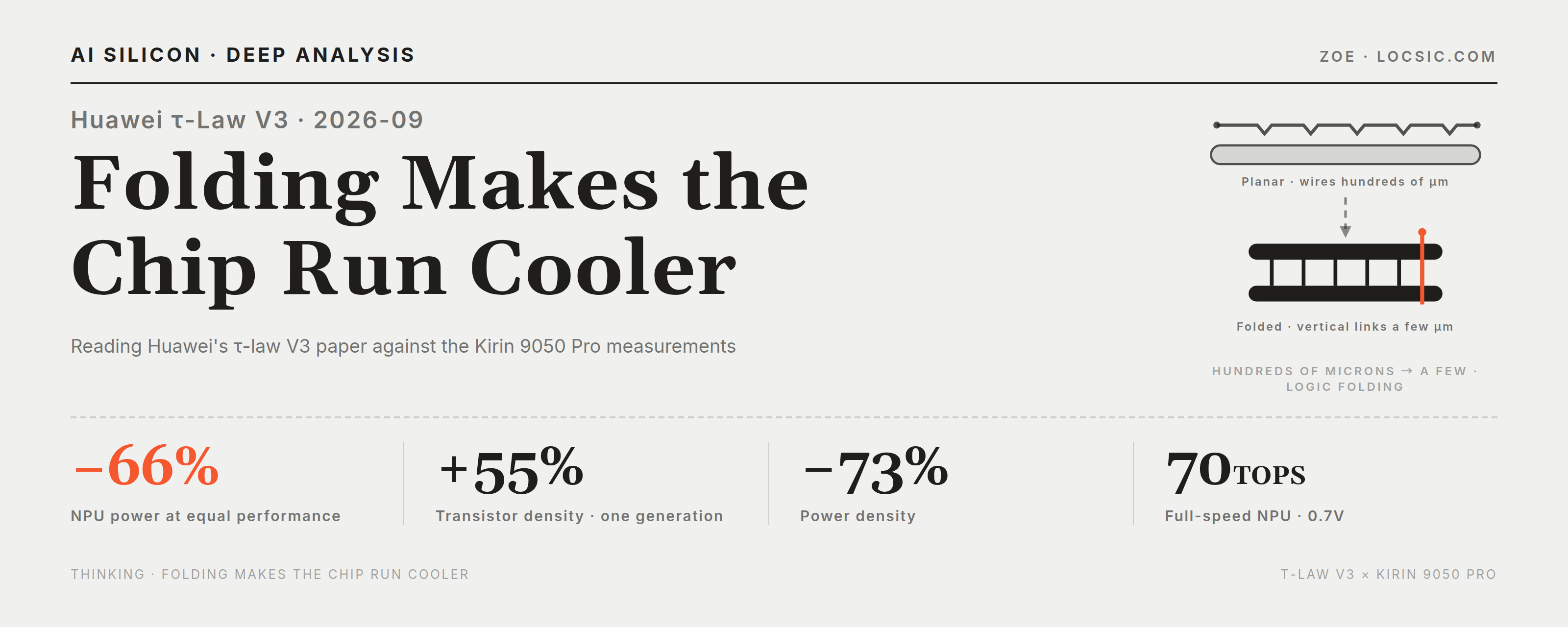
Logic folding lifts transistor density by 55 percent, and the instinct says the chip should run hotter and burn more power. Huawei's third τ-law paper, titled "Huawei's τ Chip Was Supposed to Melt?", answers head-on: in large AI clusters more than 80 percent of energy goes to data movement, and smartphone SoCs show the same imbalance to a milder degree, so folding shortens wires and spends a doubled transistor budget on voltage, cutting NPU (neural processing unit) power 66 percent at equal performance. This essay unfolds the paper’s full argument — the two energy accounts, power falling with the square of the supply voltage, the redirection of the thermal argument — and audits it line by line against Geekerwan’s Mate XT2 measurements: three fits (single-core gain almost exactly equal to the frequency gain; the multi-core efficiency curve in the same tier as the Dimensity 9400; NPU measured 67.7 against the paper’s 70 TOPS (trillion operations per second)) and one gap (the launch event’s 142 percent versus the paper’s 42), with three judgments and the dates that will decide them.